Student Team Publicizes New Data On Strength of Cluster Bomb Treaty
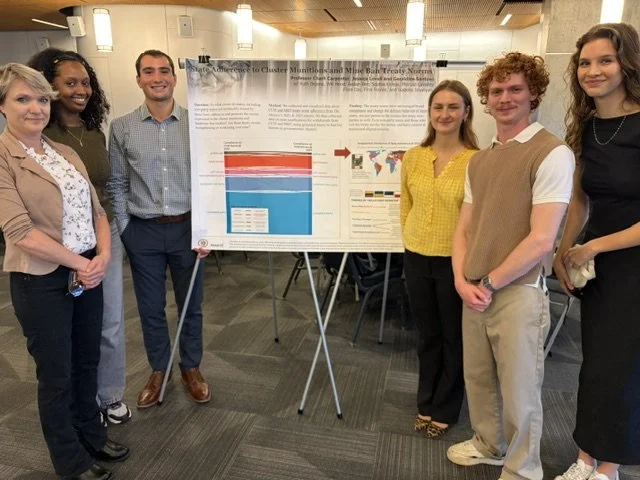
The Human Security Lab undergraduate team presenting their work.
On Friday, October 2, undergraduate students from Human Security Lab presented research on “State Adherence to Cluster Munitions and Mine Ban Treaty Norms” at the Northeast Law and Society Retreat hosted by the Center for Justice, Law, and Societies at UMass Amherst. Professor Charli Carpenter, Jessica Lovell, and doctoral researcher Geraldine Santoso, with undergraduates Ruth Dejene, Will Hood, Aeden Kerr, Sophia Knieps, Morgan LaValley, Flora Day, Finn Fosnot, and Isabella Ishanyan, compiled, analyzed and visualized data to produce a working paper titled “Beyond Compliance: The Effects of the Cluster Munitions Convention on International Security.”
In Spring 2026, Human Security Lab updated an earlier 2021 dataset to produce the working paper. The student team from the Lab presented its findings to Richard Moyes, Executive Director of Article36, a lead NGO in the humanitarian disarmament space, and presented data on cluster munitions norm strength at the Norms Under Pressure practitioner workshop in London. The Human Security Lab’s research on the strength of the Cluster Munitions Convention and on the rhetoric of states withdrawing from the treaty will be incorporated in an upcoming output document from Article36, and the working paper will be published on the Article36 website.
Despite rhetoric around the compliance and enforcement of these treaties often being negative, the student-faculty team found that the norms in place have led to dramatic shifts in both state parties and non-state parties’ behavior. The authors plan to submit the working paper for publication in a scientific journal this year.