Faculty/Student Team Briefs Humanitarian NGO on Cluster Munitions Data
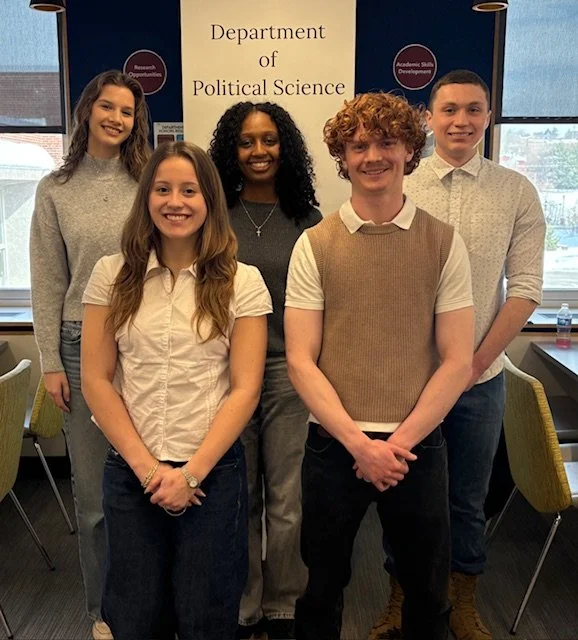
Five University of Massachusetts Amherst undergraduate students associated with Human Security Lab helped prep for and participate in a briefing with humanitarian disarmament practitioners this term: creating, visualizing and presenting new data on shifts in adherence to the cluster munitions treaty.
The project is part of a new collaboration between Human Security Lab and Article36.org, a leading NGO in the humanitarian disarmament space, on the resilience of human security norms such as those around landmines and cluster munitions, even when some countries are withdrawing from and/or violating the terms of the treaties.
Undergraduates Ruth Dejene, Will Hood, Aeden Kerr, Sophia Knieps, and Morgan LaValley joined doctoral researcher Geraldine Santoso and Professor Charli Carpenter in refining, expanding and visualizing a dataset on countries’ adherence to the Convention on Cluster Munitions convention this term. “These represent some of the world’s most indiscriminate weapons, which are now being used in the war between US, Israel and Iran,” Carpenter said. Still, Carpenter wrote in a new article at World Politics Review, the fact that the US, Israel and Iran are all condemning one another’s use of the weapons actually promotes the norm against their use.
The initial results, based on consolidated global data over a period of years, were presented to Richard Moyes, Executive Director of leading humanitarian disarmament NGO Article36.org, the week before Spring Break. They show that although some states still violate regime norms, in general terms both rhetorical and behavioral compliance with the treaty norms is actually getting stronger, not weaker.
According to Professor Carpenter, “Applied research projects like these help students learn and empower human security practitioners. It’s great when science can feed the social change agents who are trying to build a saner world.” The students themselves agreed: senior political science major Morgan LaValley said, "Contributing to a project like the cluster munitions monitor gives me both research experience but also makes me feel like I'm helping to solve a real world issue." Policy major Will Hood said, “It's been really meaningful for me to be researching topics that are so relevant today, especially as we seem to be shifting into a time of more uncertainty.”
The students themselves echoed how much they learned from the hands-on research about material they were initially studying in class. Freshman research assistant Sophia Knieps said, “Through gathering and interpreting data, my understanding of what it means to comply with an international treaty has changed."
The data collection and analysis process will continue after Spring Break, expanding to include an analysis of political rhetoric by states toward the Cluster Munitions treaty and culminating in a working paper to be co-published by Human Security Lab and Article36 in the next months.